What to Track in a Workout Log: Essentials, Extras, and Noise

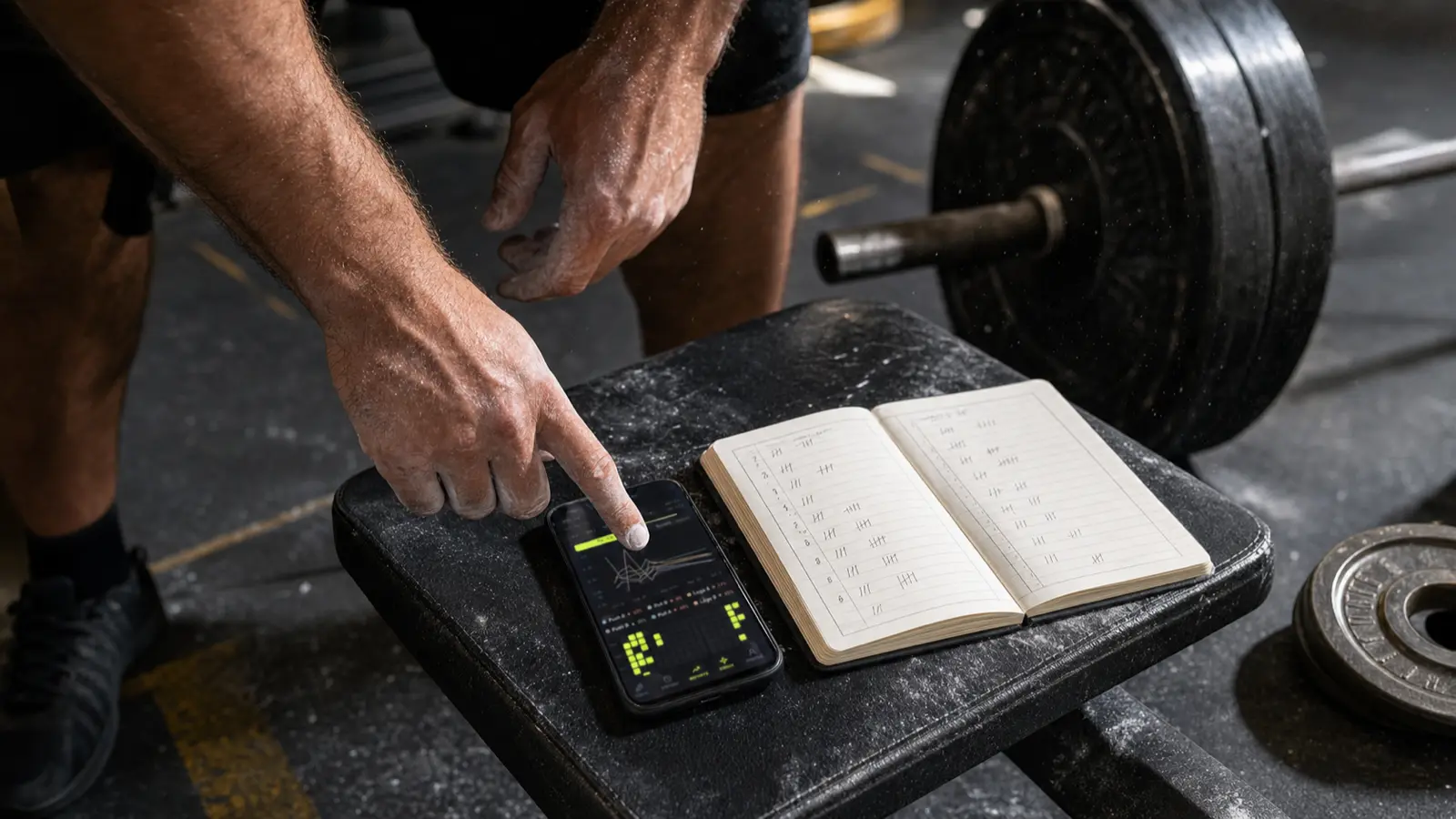
What to track in a workout log is simple: record the date, exact exercise, weight, reps, and every work set. Add effort, rest, or a note only when it will change a future choice.
What to track in a workout log first
It is easy to build a log with 20 fields, use it twice, and quit. More data does not make a better log. Useful data does.
Ask, "What will I do differently because I wrote this down?" If you have no answer, leave it out.
A simple three-tier setup works for most lifters:
| Tier | What belongs there |
|---|---|
| Essentials | Date, exact exercise, sets, reps, and weight |
| Useful extras | Effort, rest time, set type, and one short note |
| Context | Bodyweight, sleep, stress, or travel when useful |
Start with the essentials. Add an extra only when you keep wishing you had it. If logging is new to you, this guide on how to track workouts covers the habit and tools.
Takeaway: start with five facts, then make every new field earn its place.
Tier 1: What to track in a workout log every set
Write the date once for the session. Then record these details for each work set:
- Exercise name and exact variation
- Weight
- Reps
- Set number
"Bench press" may be too vague. Was it flat barbell bench, incline dumbbell bench, or close-grip bench? Grip, angle, machine, and range of motion can change the result.
Suppose you do incline dumbbell bench at 20kg (44 lb) for 10, 9, and 8 reps. Your clean entry is:
Incline dumbbell bench, 30-degree bench: 20kg x 10, 9, 8
Mark warm-up sets so they do not sit beside hard sets as if they were equal. For assisted bodyweight work, write the help you used, such as a 15kg (33 lb) assist on pull-ups.
Takeaway: name the exact movement and record each work set, so next time you compare like with like.
Tier 2: Effort, rest, and special sets
These fields take a few more seconds, but they can explain why the same weight felt different.
RPE or reps in reserve
RPE is a 1 to 10 effort score. Reps in reserve, or RIR, means how many clean reps you think you had left. On the common scale, RPE 8 means about 2 reps left. It is a rough self-rating, and newer lifters may find it hard to judge. Pick one system.
You do not need to score every warm-up. Log effort on your hardest work sets. If 60kg (132 lb) for 8 moves from RPE 9 to RPE 7 over a few weeks, the set likely got easier even before the load changed.
Rest time and quick notes
Rest time keeps sessions comparable and can explain a rep drop. Eight reps after three minutes is not the same test as eight reps after one minute. Log an exact time or a usual range, such as 90 to 120 seconds.
Keep notes short: "left shoulder tight" or "last rep messy." A note should explain a number, not retell your day.
Record a drop set as a main set with a drop tail. For example: 50kg x 8, then 40kg x 6, then 30kg x 7. Do the same for back-off sets and failed reps. Do not mash the whole chain into one set.
Takeaway: add effort, rest, and set type when they explain what the raw reps cannot.
Context and useful numbers your log can calculate
Context belongs beside the session, not inside every set. Use it when it may explain a pattern.
- Morning bodyweight: useful as a weekly trend during a cut or muscle-gain phase
- Sleep: hours or a simple poor, fair, good score
- Readiness: one honest score before training
- Stress or travel: a note when your routine was broken
- Form cue: a phrase such as "pause on chest" or "full depth"
Water, food, and bathroom timing move bodyweight around. Compare weekly averages, not single mornings.
Your log can turn set data into an estimated one-rep max, or estimated 1RM. This is a rough guess at the most weight you could lift once. The Epley formula is:
estimated 1RM = weight x (1 + reps / 30)
If you lift 80kg (176 lb) for 5 reps, the estimate is 80 x (1 + 5 / 30) = 93.3kg (206 lb). It is not a promise. Use it to watch the same exercise over time. This guide to estimating your 1RM compares the main formulas.
Simple volume, weight x reps, is a rough workload check. A high total on a machine is not equal to the same total on squats. It is context, not a score.
Takeaway: use context to explain trends, and use calculated numbers as clues rather than verdicts.
Workout log fields you can usually skip
Some fields look serious but rarely change a choice.
- Calories burned during lifting: watches and machines only estimate this. The number does not show whether you built strength.
- Detailed tempo for every rep: "3 seconds down, 1 second pause, 1 second up" can help during a planned tempo block. A beginner can often use "controlled reps."
- Mood scores: keep them only if you review them and find a pattern.
- Pulse, room temperature, or gym crowd level: these may matter for endurance or a special test. Most strength logs do not need them.
- Long diary entries: they are hard to scan when you need last week's target.
Range of motion and form still matter. Log them when the rule changed or a rep was not honest. "Half depth" beside a squat stops you from calling it a clean record.
Takeaway: skip any field you never review, unless it explains an unusual result.
Match the workout log to your goal
If you are a beginner
Use the five essentials before adding scores and formulas.
If strength is your goal
Add RPE or RIR, rest time, and estimated 1RM. These show whether a heavy set improved, not only got heavier.
If muscle size is your goal
Track work sets, rep ranges, and rest. Add weekly average bodyweight, a few body measurements, and monthly photos taken under the same light.
If endurance is your goal
Track duration, distance, pace, route, and heart rate if you have a reliable monitor. Outdoors, heat and wind can change pace.
Takeaway: choose fields for your goal, not because another lifter's log looks impressive.
Turn each logged field into a decision
A log becomes useful when it changes the next workout.
- Weight and reps: use them to set the next target. With double progression, you climb from 8 toward 12 reps. Once every set reaches 12 with clean form, add about 2.5kg (5 lb) and return to 8.
- Effort: if the same load and reps feel easier, you may be ready to progress. If effort stays high for several sessions, check sleep, rest, and form.
- Rest: if reps rise only because rest grew from one minute to four, the lift did not improve under the same test.
- Notes: repeated "poor sleep" notes beside weak sessions point to a recovery issue. One bad day is noise.
- Variation: if you changed grip or range of motion, start a new comparison.
Review the last session before you train. Scan the past four to six weeks once a month. Look for a direction, not a perfect line.
Takeaway: every field should answer one question about what to repeat, change, or leave alone.
Keep what to track in a workout log fast
Logging must fit between sets. If a field takes too long to enter, cut it.
Pre-filled targets let you confirm a number instead of typing it again. Voice entry helps when your hands are chalky. Clear labels keep warm-ups, work sets, and drop tails separate.
Ironi keeps its tracker and voice logging free forever. It can pre-fill targets, store each drop after its main set, and work out estimated 1RM and personal records.
Try the two-second test for every field: can you record it in about two seconds, and can you name the choice it will change? If either answer is no, remove it.
A workout log should be easy to read next week while you are standing beside the bar.
Takeaway: a short entry you make every set beats a detailed entry you stop making.