Voice Workout Logging: Log Your Sets Hands-Free Without Breaking Your Flow

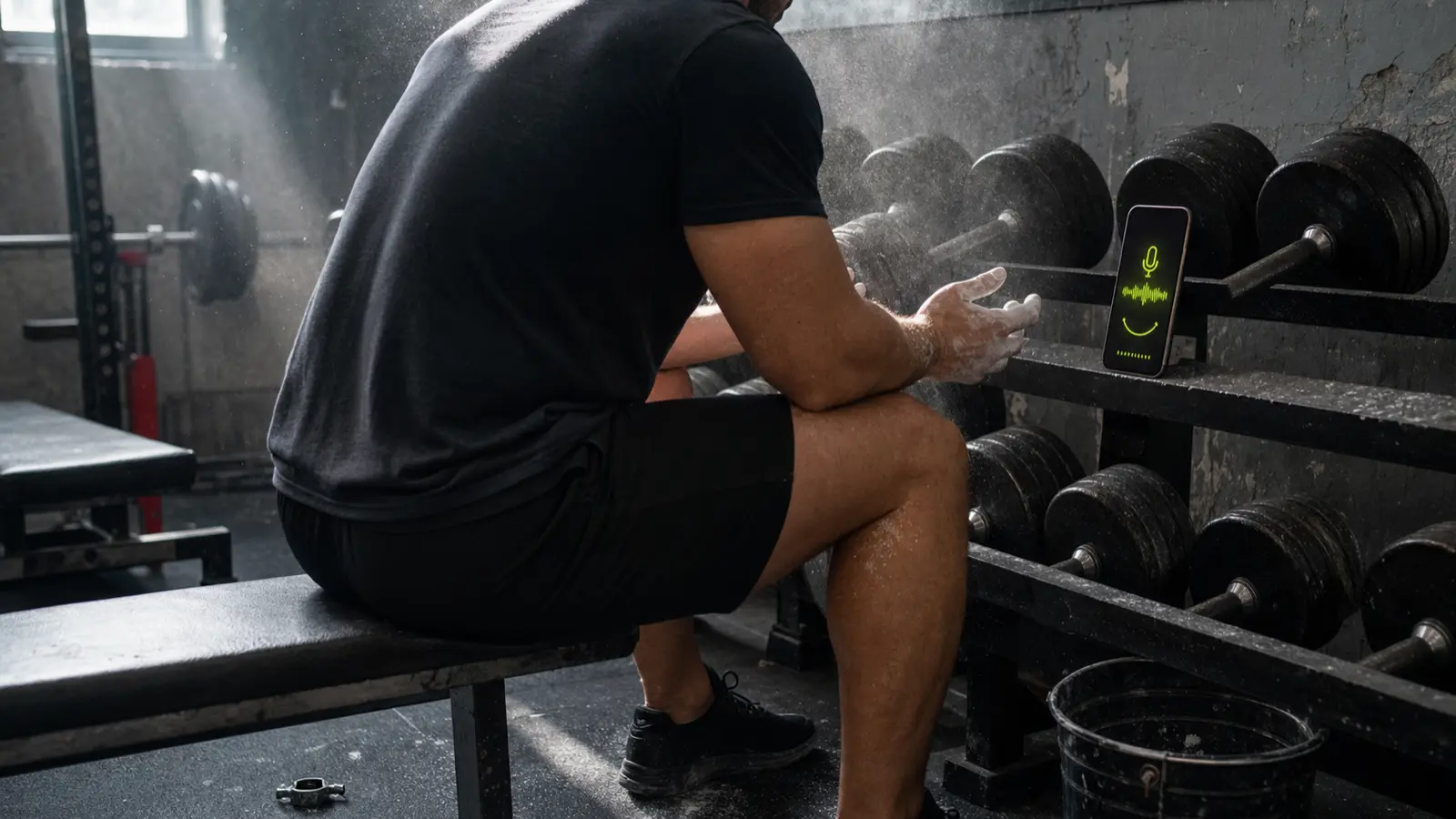
Voice workout logging means you say your set out loud, "bench press, 60 kilos for 8", and the app writes it down for you. No typing, no hunting for the exercise, no wiping chalk off your thumb to hit tiny plus buttons. You speak, the numbers appear, you tap once to confirm, and you go lift again.
It sounds like a gimmick until you finish a heavy set of deadlifts with chalked hands, straps still on your wrists, and log the whole thing without touching the screen. Then it just feels obvious.
What voice workout logging actually is
It's one input method, not a whole new kind of app. A good tracker lets you tap the pre-filled numbers, type them, or say them. Voice is for the moments when your hands are busy or filthy.
You speak in plain language, no robot commands. All of these work in a decent implementation:
- "Bench press, 60 kilos for 8"
- "8 reps at 60"
- "Sixty for eight"
The app pulls out the weight, reps, and unit, then drops them into the set you're on. If you expected more magic, good. Logging should be boring.
Takeaway: voice logging is just the fastest pencil you own. Say the set, check it, move on.
How voice logging works under the hood
No app explains this part, which is exactly why you should read it. Three steps:
- Speech-to-text. The app records a short clip (usually capped around 15 seconds) and a transcription model turns it into text. Good apps bias the model toward gym words so "lat pulldown" doesn't come out as "flat pull down".
- Parsing. A parser reads the text and pulls out the numbers. "Sixty" becomes 60, units get handled, and word order gets untangled: "8 at 60" and "60 for 8" mean the same set, because the smaller number is almost always the reps.
- Fill and confirm. The parsed numbers fill your active set. Nothing is saved yet. You glance at "8 x 60kg" and tap Log.
That third step matters most. A tracker is only useful if you trust every row, and speech recognition is not perfect. An app that auto-saves whatever it heard will eventually write "8 reps at 16kg" into your bench history because the music was loud. One bad row poisons your history and your next targets.
So here's the rule: voice should fill the set, never log the set. If an app auto-saves voice input with no confirm step, that's not a feature. That's a liability.
Takeaway: speech-to-text, then a parser, then YOU confirm. Never trust an app that skips step three.
The real speed advantage of hands-free set logging
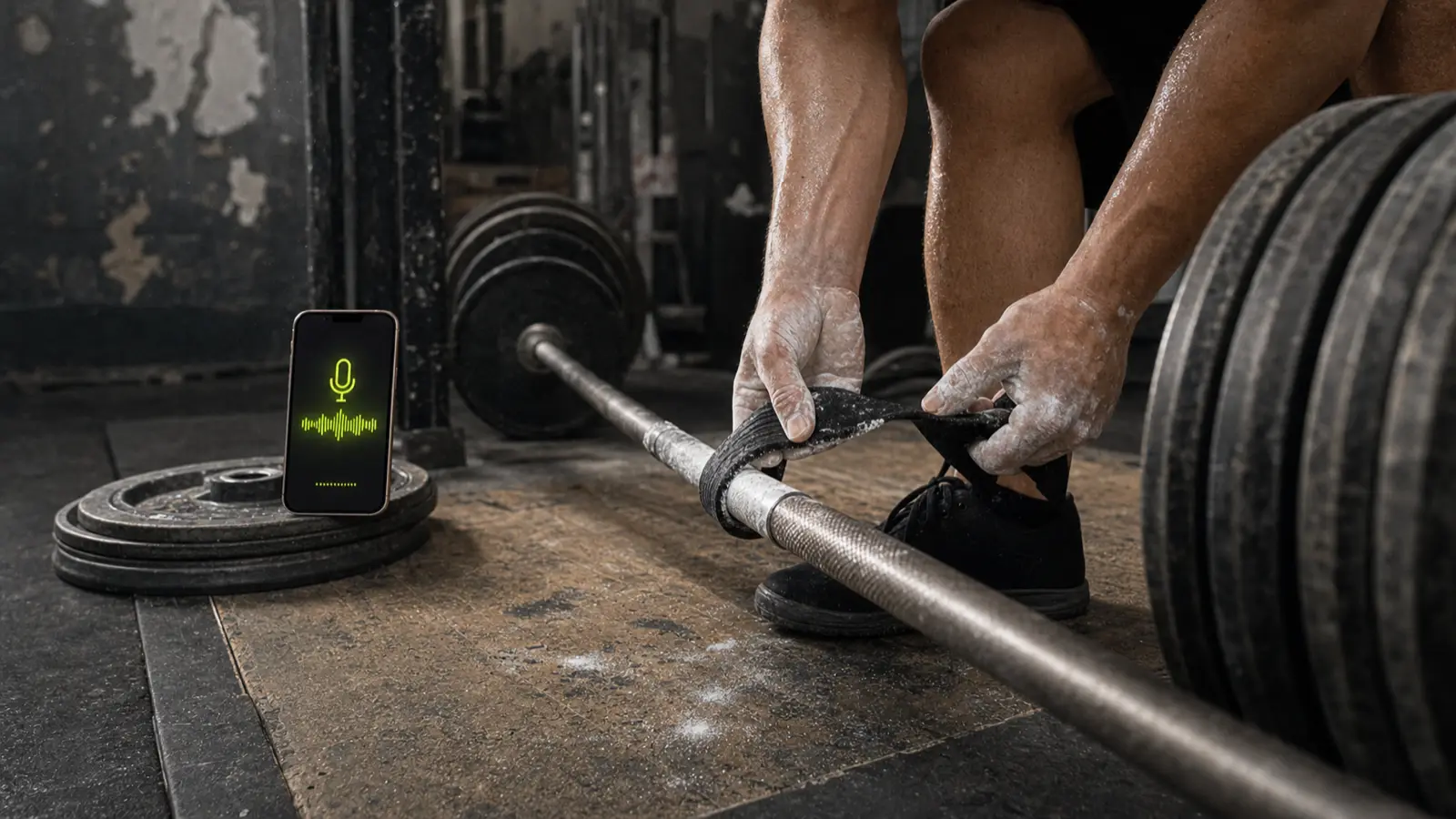
How much time does it save? One hands-on test (Jefit's blog, comparing set logging across seven apps) clocked the fastest voice logging at about 2 seconds per set, against 3 to 4 seconds of tapping. Over a 25-set session that's under a minute saved.
But the seconds were never the point. The point is what your hands are doing:
- Chalk and straps. After heavy pulls your hands are white. Touchscreens hate chalk.
- Short rest. Fumbling, drying your hands, unlocking the phone: that eats a 60-second rest.
- Supersets. You're walking from the dip bar to the curl rack. Say the set on the way.
- Gloves and hook grips. Some hands just don't type mid-session.
Tapping still wins sometimes. In a quiet home gym, talking to your phone feels silly. And if the app pre-fills your target and you hit it exactly, confirming is one touch, which no voice flow beats.
Takeaway: voice wins when your hands are busy, chalked, or strapped. Taps win for quiet rooms and tiny tweaks. Use both.
Let's be honest about accuracy
Voice logging fails sometimes, and any article that skips this is selling you something. The same hands-on test found voice input failed roughly 10% of the time in a noisy gym. That matches reality: clanging plates and loud music are the worst possible recording booth.
What trips it up:
- Noise. The mic catches the gym speaker better than your voice.
- Accents. Models are better than they were, but "thirty" and "thirteen" still collide.
- Phrasing. "60 for 8" and "8 at 60" flip the number order. A dumb parser gets this backwards.
- Units. Say "pounds" to an app set to kilos and a lazy implementation stores 135kg.
How good apps fight back: a gym-domain prompt for the transcription model, deterministic parsing rules like "the smaller number is the reps", unit conversion before anything fills, and the confirm step, which turns every failure into a two-second fix.
A 10% miss rate is annoying when the fix is one tap. It's a disaster when the app already saved the wrong set.
Takeaway: expect roughly one miss in ten sets in a loud gym. Pick an app where a miss costs you a tap, not your data.
A full set, logged by voice
Here's the flow in Ironi, the tracker I build and train with, where voice logging is part of the free-forever tracker:
- Mid-workout, a mic button floats on the screen.
- Finish your rows. Tap the mic with a knuckle (chalk-proof).
- Say "70 for 10". Tap again to stop, or just wait.
- A second later, the active set fills in: 10 reps, 70kg. A small pill shows what it heard.
- You actually got 9? Tap the minus stepper once.
- Tap Log. The set saves and your hands never scrubbed a screen.
If the parser can't find numbers, nothing fills and you get a "didn't catch that" hint, not a garbage row. The Log tap is always yours.
Takeaway: mic, speak, glance, Log. Four beats, and the glance is the one that keeps your history clean.
Privacy: where does your voice go?
Fair question, since you're handing an app your microphone inside a gym full of other people's conversations.
On-device transcription keeps the audio on your phone. Cloud transcription uploads the clip, converts it to text, and sends the text back. Cloud usually handles noise and accents better, but the clip does travel.
Before you grant mic access to any app, check three things:
- When can it listen? Only while you're actively logging, never in the background. A hard cap on clip length is a good sign.
- Is the clip stored? The answer you want: transcribed, then discarded. If the privacy policy is silent on audio retention, assume the worst.
- What's in the recording? Short, deliberate clips ("60 for 8") barely contain anything. An always-listening mode would. Avoid those.
Takeaway: tap-to-record with a short cap and no stored clips is fine. Anything always-on has no business in a gym.
Should voice logging cost extra?
Apps are still deciding where voice sits. Some already charge: one voice-first app caps free voice commands and sells unlimited voice in a $9.99 a month Pro tier. Easy to see where this goes, because voice runs on AI, and AI is what people pay for right now. I think that's the wrong line to draw.
Here's a cleaner split: pay for thinking, not for typing. Coaching, plan generation, and analysis are judgment calls, and charging for judgment is fair. But logging is the bare minimum function of a tracker, and voice is just the fastest way to do it. Paywalling the fastest input method makes the free tier deliberately slower, and a slower logger is one you'll quit. That's why voice stays free in the tracker above, while the AI trainer is the paid part. If you're comparing options, my roundup of free workout apps without a subscription flags exactly what each one gates.
Takeaway: coaching is worth paying for. Recording your own set faster isn't. Judge any app by where it draws that line.
Is voice workout logging right for you?
Quick sort:
- Great fit: crowded commercial gyms, heavy days with chalk and straps, supersets, anyone who hates rest time being eaten by a screen.
- Weak fit: silent home gyms, lifters who hit pre-filled targets exactly, tiny corrections like changing 8 to 9.
The lifters who log most consistently don't pick one input method. They stack the low-friction options: targets pre-filled from last session, taps for normal sets, voice for the chalked-up heavy ones. The method matters less than the streak.
Takeaway: try voice for one heavy session. If you log every set without breaking your rest, it earned a permanent spot.