Workout Volume Explained: Sets x Reps x Weight (and Why It Matters)


Workout volume explained simply: it is the total work you do, often counted as sets x reps x weight. You can use that number to compare similar workouts over time. For planning muscle growth, it is often more useful to count hard sets for each muscle each week.
Workout volume explained: what it actually is
The common formula for load-volume, also called tonnage, is:
sets x reps x weight
Say you squat 60 kg (132 lb) for 3 sets of 8:
- 3 x 8 x 60 kg = 1,440 kg
The same formula works in pounds. If the bar is 135 lb:
- 3 x 8 x 135 lb = 3,240 lb
Why call it volume? Think of the three parts like the sides of a box. More sets, more reps, or more weight makes the box bigger. Your total work goes up.
Warm-up sets can add to the math, but many lifters count work sets only. Pick one method and keep it the same, or a longer warm-up may look like progress.
Takeaway: multiply sets, reps, and weight, then use the same counting rule every time.
Workout volume explained: volume vs intensity
Volume tells you how much work you did. Intensity tells you how heavy the load was compared with your one-rep max, or 1RM. Your 1RM is the most you could lift for one clean rep.
If your squat max is 100 kg (220 lb), then 80 kg (176 lb) is 80 percent intensity. Five reps there may feel much harder than ten reps with 50 kg (110 lb), even if the lighter set creates more tonnage.
You can change one without changing the other. Adding a set raises volume. Adding weight while cutting reps may raise intensity but keep volume close. Even one extra rep lifts the volume a little.
Strength work often needs higher intensity. Muscle and endurance work can use many loads if you recover from the sets.
Takeaway: volume is how much you did; intensity is how heavy it was for you.
The two useful definitions of workout volume
Gym talk uses "volume" in two ways, and each answers a different question.
Load-volume or tonnage answers, "Did I do more total work than last time?" Compare the same exercise with similar form and range of motion.
Hard sets per muscle per week answers, "How much growth work am I giving this muscle?" A hard set is a work set that takes real effort and ends with only a few clean reps left. Easy sets still have uses, but they do not give the same growth signal.
Tonnage has a big blind spot:
- 5 x 5 x 40 kg (88 lb) = 1,000 kg
- 2 x 5 x 100 kg (220 lb) = 1,000 kg
The totals match, yet the sessions are not alike. One has more sets with a light load. The other has fewer sets with a heavy load. Tonnage also cannot tell how close you came to failure or whether you compared squats with curls.
Use tonnage for your own trend on the same lifts. Use weekly hard sets to plan muscle work.
Takeaway: tonnage tracks a repeated workout; hard sets help you plan the week.
Why workout volume matters for your goal
For muscle growth, hard sets give your body a reason to build. Once the useful work is done, extra sloppy sets may only add fatigue.
Strength still needs volume to practise the lift and build muscle, but heavy work leads. Ten easy sets cannot replace time near your strength limit.
Endurance uses more reps and longer sets. Tonnage may rise fast because the loads are lighter.
During fat loss, lifting can help you keep muscle. Food intake still drives most of the change, so do not turn every lifting day into a two-hour calorie chase.
Your goal changes what a good session looks like. It does not make recovery optional.
Takeaway: match the type of volume to the result you want, then stop before useful work turns into junk.
How much workout volume do you need?
There is no perfect set count for every person. These are rough starting ranges per muscle group each week:
- Newer lifters: about 6 to 10 hard sets
- Intermediate lifters: about 10 to 15 hard sets
- Experienced lifters: sometimes 15 to 20 or more, if recovery and results support it
Many lifters can start near 10 weekly sets per muscle. Advanced does not mean you must reach 20. Some experienced lifters grow well on less, and some muscles handle more than others.
Hold that amount for 3 to 4 weeks. If reps, weight, and form improve, keep it. If progress is flat but sleep, food, and effort are good, add 1 or 2 weekly sets and watch again.
This is the useful idea behind minimum effective and maximum recoverable volume. The first is enough work to get a result. The second is more than you can recover from. You want the wide middle, not either edge.
Takeaway: start near the lower end, watch your results for a few weeks, and earn any added sets.
Volume as a progress signal
A volume PR is a new personal best in tonnage for a similar workout. It can show progress even when the weight stays the same.
Suppose your bench session was 3 x 8 x 60 kg (132 lb), or 1,440 kg. Next time, you have two clear ways to beat it:
- 3 x 8 x 62.5 kg (138 lb) = 1,500 kg
- 3 x 9 x 60 kg (132 lb) = 1,620 kg
That is progressive overload, which means doing a little more over time. You can use last session's total to plan the next one, but do not force the target after a bad night or when your form slips.
A rising volume trend is only one signal. Check it beside rep PRs and estimated 1RM, which predicts your max from a hard set. This guide explains how to know if you are making progress in the gym using the full picture.
Takeaway: compare like with like, and treat a clean rise in tonnage as one useful sign of progress.
How to track volume without a spreadsheet
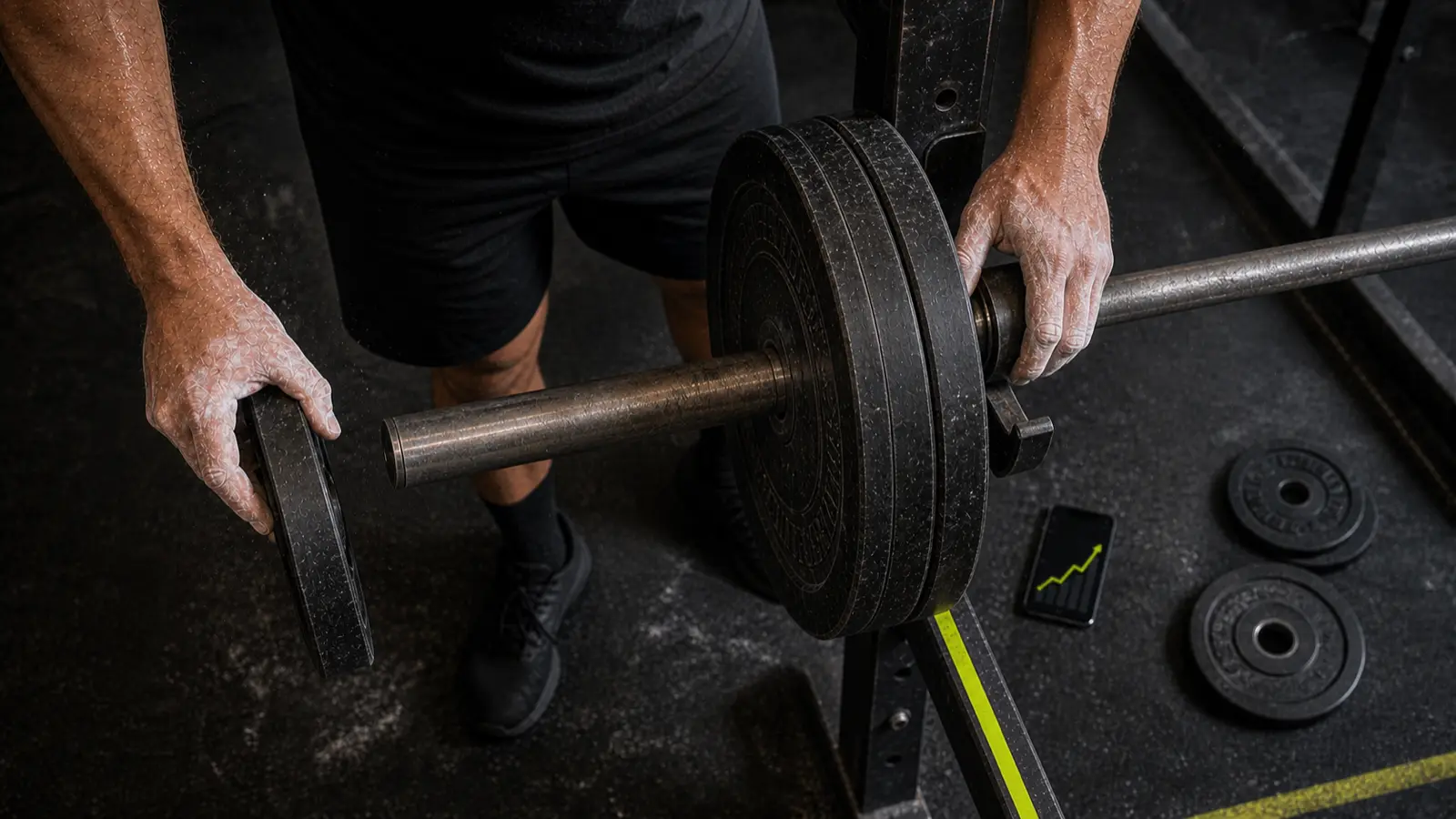
You can calculate each set and add the results every week, but that gets old by exercise three.
A log should keep the exercise, sets, reps, and load. Then you can see whether an extra 500 kg came from better work or random filler. For a simple logging routine, try the double progression method.
Drop sets count too. If your main set is 8 reps at 60 kg (132 lb), that set adds 480 kg. A drop of 6 reps at 40 kg (88 lb) adds another 240 kg. Together they add 720 kg.
Partials use the same formula, but mark them. A half rep is not a clean match for a full rep. Bodyweight moves are harder to score because the formula needs a load. Any estimated bodyweight load will be rough, so track reps and form too.
Ironi totals load-volume from your logged sets, includes drop-set tails, and shows the trend without manual formulas. The workout tracker is free forever.
Takeaway: log the sets as they happened, including drops and partials, and let the total be a result rather than a chore.
Signs your volume is too high
One rough workout proves very little. A pattern across a week or two matters more. Check for:
- Lifts that stall or go backward for several sessions
- Sleep that gets worse even when your bedtime stays steady
- Joints that ache before the warm-up
- Soreness that lasts into the next workout for that muscle
- Dread before sessions you usually enjoy
First, trim sets with poor form or little effort. If fatigue covers your whole week, deload for one week by cutting sets, load, or both. Then return and see how you perform.
Check the boring causes too. Low sleep, low food, life stress, or a sudden jump in training days can look like too much volume. Your log shows what changed. Your body shows whether you handled it.
Volume is useful because you can measure it, not because the biggest number wins.
Takeaway: when performance and recovery fall together, cut junk sets or deload before you add anything.