When to Add Weight When Lifting: The Simple Rule (and How to Know You're Ready)


When to add weight when lifting is simple: add weight the session you hit the top of your rep range on every work set, with good form. Not the first set. Not because it felt easy. All of them. That is the trigger, and it beats lifting by feel because it gives you a yes or no answer you can actually check.
The short answer: when to add weight
Most people wait for a lift to "feel easy" before going heavier. Bad rule. Easy drifts. A lift feels light on a good night's sleep and heavy after a rough week, so you either add too soon or never add at all.
A fixed rep range fixes that. Pick a range like 8 to 12. Keep the weight the same and chase reps every session. The day every work set reaches the top number, you have earned the jump. That is it. This is the double progression method in one line: reps first, then weight.
- Feel is a mood. A rep count is a fact.
- The top of the range is your green light, not a hunch.
- Warm-up sets never count. Only work sets vote.
Takeaway: stop asking if it felt easy. Ask if every set hit the top.
The readiness checklist: are you actually ready to add weight?
Topping the range on one set is a preview, not a green light. Your first set is always your strongest. Run down this checklist before you load the bar:
- Every work set hit the top. All of them, not just set 1.
- Form held on the last reps. A bounced or half-range rep does not count.
- You had a rep or two left. If the last set was a shaking grind to hit the number, you are not ready.
- It held for the whole session. One lucky set on a caffeine high is not the same as a solid day.
Miss any of these? Stay at the weight and chase reps again next time.
Takeaway: all sets, clean form, a little left in the tank. Then you add weight.
How much weight to add
The jump depends on the lift, not on how strong you feel. Bigger muscles and heavier bars take a bigger plate. Small muscles get wrecked by the same jump.
| Lift type | Jump to add |
|---|---|
| Big barbell lifts (squat, bench, row, deadlift) | 2.5kg (5lb) |
| Heavy lifts past ~100kg (220lb) | 5kg (10lb) |
| Small isolations (lateral raise, curl) | 1 to 1.25kg (2.5lb) |
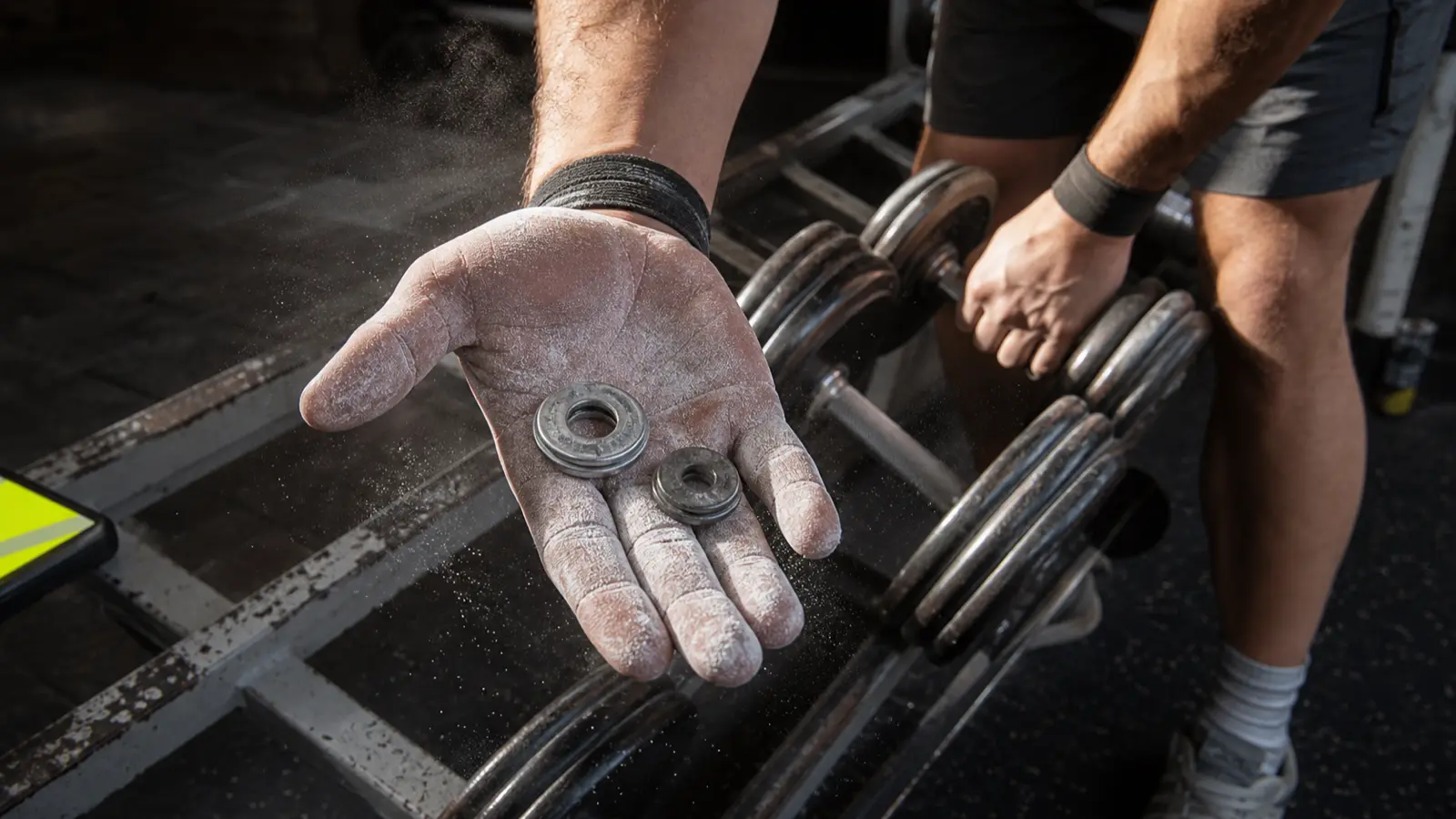
Here is the part most guides skip. On a squat, 2.5kg is a rounding error, well under 5 percent of the load. On a lateral raise with 8kg dumbbells, the next bell up is often 10kg, a 25 percent jump that turns a clean set into a mess overnight. Same 2.5kg, completely different lift.
The fix is micro-loading. Small plates of 1 to 1.25kg let you creep up on lifts where the standard jump is too brutal. They cost about as much as a protein tub, fit in your gym bag, and keep small lifts moving instead of stuck for months.
Takeaway: big lift, small plate feels tiny. Small lift, buy micro-plates.
How often should you expect to add weight?
Adding weight every week forever is a beginner fantasy. It slows down for everyone, and that is not you failing. Rough guide:
- Beginners: most sessions or weekly. Your body is soaking up the new stress fast.
- Intermediate: every 1 to 3 weeks per lift. The reps do the work between jumps.
- Advanced: slower still, sometimes a month or more per lift. Normal.
Legs move faster than arms. A squat or leg press climbs quicker than a curl or a lateral raise, because the big lower-body lifts have more muscle to grow and take a smaller percentage jump. So do not compare your bench to your squat. Different lifts run on different clocks.
Takeaway: the stronger you get, the slower you climb. Slow is the deal, not a stall.
What happens the session after you add weight
Your reps will crash. That is the plan, not a problem. You traded reps for load, so now you buy them back over the next few sessions. Watch it play out on a squat, 3 work sets, 8 to 12 range:
| Session | Weight | Reps | What you do |
|---|---|---|---|
| 1 | 60kg (132lb) | 12 / 12 / 12 | All sets topped. Add 2.5kg |
| 2 | 62.5kg (about 138lb) | 9 / 8 / 8 | Reps dropped. Expected. Stay |
| 3 | 62.5kg | 10 / 9 / 8 | Climbing. Stay |
| 4 | 62.5kg | 11 / 10 / 9 | Keep chasing reps |
| 5 | 62.5kg | 12 / 12 / 12 | Topped again. Add weight |
Session 2 looks like you got weaker. You did not. Going from 12 reps to 9 at a heavier load is more total work, not less. Give any new weight 2 or 3 sessions to climb before you call it anything. One flat day is sleep or stress, never a plateau.
Takeaway: the rep crash after a jump is the reset. Ride it up, do not panic.
When not to add weight
Sometimes the honest move is to hold, or even go back down. Do not add weight if:
- Only your first set hit the top. Sets 2 and 3 will get buried.
- Form fell apart or the last reps turned into a grind.
- You are running on no sleep or a bad week. Hold, let it come back.
And if you did add too soon? Back it down. The reps refuse to climb for 2 or 3 sessions straight, everything feels like a fight, so you drop back to the old weight and rebuild. No shame in that. Micro-load the second attempt if you have the plates: jump 1.25kg instead of 2.5kg and the climb is easier. Backing down for a week is not a loss. It keeps the streak alive. A stubborn stall costs you months.
Takeaway: holding is smart, walking back is smart. Grinding a weight you are not ready for is not.
How to know when to add weight without doing math
Here is the catch nobody mentions. The whole rule rests on one thing: remembering last session's exact reps at this exact weight. Did you hit 12/12/11 or 12/12/12 on the squat last Tuesday? On the third exercise of a six-exercise day, from ten days ago? Nobody remembers that.
Paper logs help, but they are homework. You flip back, read last week, do the compare in your head, and apply the all-sets rule yourself before every exercise. Miss one number and the trigger is gone. If you want to double-check real progress over time, here is how to tell a plateau from normal noise.
Or let the app carry it. Ironi reads your last session and shows the exact reps and weight to beat on every set, then flags the moment all your sets top the range and it is time to add weight. Set a custom jump per exercise if you want (1.25kg on lateral raises), and the tracker is free forever. You stop being the calculator and just lift.
Takeaway: the rule is simple, the memory is the hard part. Log it, or let the app watch the numbers for you.
FAQ
How do I know if I added too much weight?
Your reps crash below the bottom of your range and will not climb after 2 or 3 sessions, and your form breaks to move the bar at all. A one-week dip is normal. A three-week fight is the sign to drop back down and try a smaller jump.
Should I add weight or add reps first?
Reps first. Climb from the bottom of your range to the top at the same weight, session by session. Only when every set hits the top do you add weight and reset to the bottom. Reps are the finer dial, so you get more progress out of them.
Is it bad to stay at the same weight for weeks?
No, as long as your reps are still climbing. Adding reps at the same weight is real progress. You only have a problem when both the reps and the weight sit frozen for a month with clean form and good rest.